How to Optimize for the Agentic Web in 2026

Introduction
AI agents inside tools like ChatGPT, Gemini, and Perplexity can now browse websites, compare options, and complete tasks such as bookings, sign-ups, and purchases. Understanding How to Optimize for the Agentic Web is essential as AI increasingly influences customer decisions.
This shift is changing how people discover brands. Instead of researching manually, users often rely on AI agents to evaluate options. Learning How to Optimize for the Agentic Web helps ensure your website is visible, trusted, and recommended by AI systems.
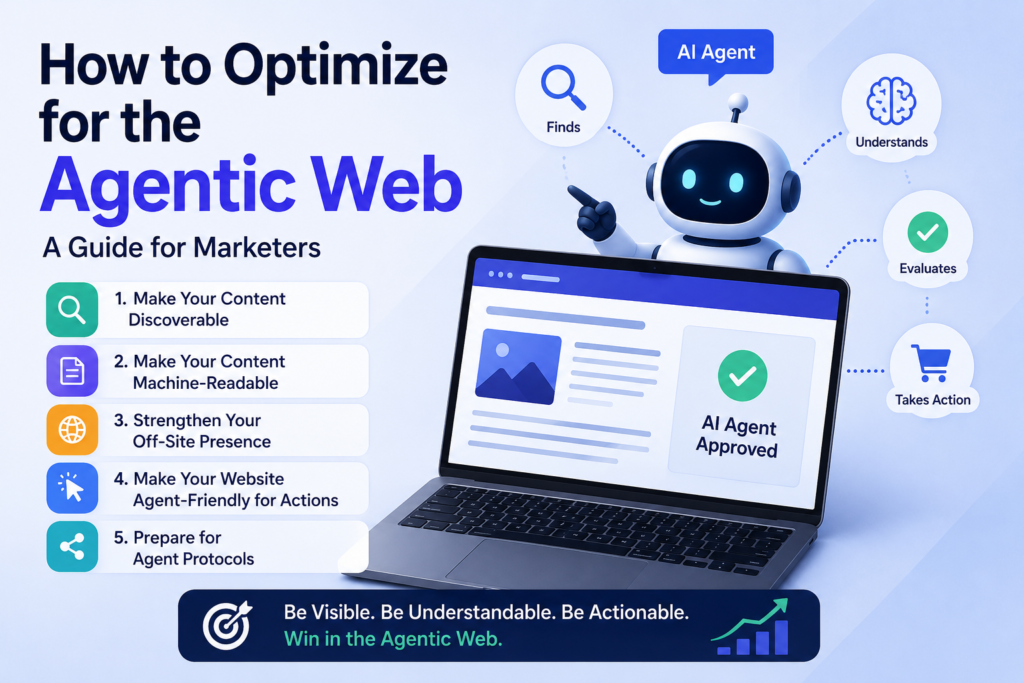
This guide explains How to Optimize for the Agentic Web using a practical five-layer framework.
What is the Agentic Web?
The agentic web refers to an internet where AI agents can browse, understand, and take actions on websites for users. Learning How to Optimize for the Agentic Web helps businesses improve their visibility and ensure AI systems can easily find and recommend their brands.
Unlike the traditional web—where users click through pages and compare options themselves—the agentic web works like this:
- A user submits a goal (e.g., “Find a project management tool for a 10-person team under $15/month with time tracking”)
- An AI agent researches multiple websites
- It evaluates features, pricing, and reviews
- It may recommend or even complete the purchase
This means websites must now communicate clearly not only to people, but also to machines making decisions.
Why Businesses Need to Become Agent-Ready
Major platforms are already developing standards for agent-driven interactions, making How to Optimize for the Agentic Web a growing priority for businesses. As AI agents become more involved in customer decisions, brands need to ensure their websites are accessible, trustworthy, and easy for AI systems to understand:
- Emerging browser standards like WebMCP
- Commerce systems such as Google’s Universal Commerce Protocol (UCP)
- OpenAI and Stripe’s Agentic Commerce Protocol (ACP) powering in-chat purchases
- AI shopping experiences already available in ChatGPT and Google AI Mode
In this environment, agents don’t just “visit” websites—they decide outcomes.
If your site cannot be understood or acted upon, users may never reach it. Competitors with more agent-friendly systems will win the transaction instead.
The Agentic Web Optimization Stack
How to Optimize for the Agentic Web involves a layered approach where each optimization step builds on the previous one. Creating a strong foundation helps AI agents discover, understand, and interact with your website more effectively.
Each layer builds on the previous one:
- SEO foundations – Ensure your site is crawlable and technically sound
- Agent readability – Structure content so AI systems can understand it
- Off-site presence – Build consistent brand signals across the web
- Action layer – Make your site usable for AI-driven actions
- Protocol layer – Implement emerging standards like MCP and ACP
Without strong foundations, higher layers will not function effectively.
5 Steps to Optimize for the Agentic Web
1. Fix Technical SEO First
Technical SEO is the foundation of How to Optimize for the Agentic Web. If AI agents cannot access, crawl, or understand your website, they won’t be able to recommend your content, products, or services.
Common issues that block visibility include:
- Incorrect robots.txt rules
- Slow page load times
- JavaScript-only content
- Broken internal links
- Redirect loops
- Server errors (5xx responses)
These issues prevent agents from properly reading your site and evaluating your content.
2. Make Your Content Machine-Readable
A key part of How to Optimize for the Agentic Web is creating content that AI agents can easily understand. Once your website is accessible, use clear language and a well-structured format to help AI systems interpret your content accurately.
AI agents don’t just read—they compare information across multiple sources. That makes clarity and structure essential.
Best practices:
- Use simple, direct language
- Clearly explain what your product does and who it is for
- Break content into structured sections
- Use headings, bullets, and short paragraphs
- Lead with key points before details
- Add FAQs that reflect real user questions
Well-structured content helps agents extract reliable information quickly.
Schema markup also improves machine understanding:
- Product schema for pricing and availability
- FAQ schema for question-based content
- Organization schema for brand identity
3. Strengthen Your Off-Site Presence
An important part of How to Optimize for the Agentic Web is building a strong off-site presence. AI agents don’t rely only on your website—they also evaluate reviews, mentions, and other trusted sources across the web to assess your brand’s credibility.
They check:
- Reviews
- Forums
- Comparison articles
- News mentions
- “Best of” lists
Consistency is critical. If your brand messaging differs across platforms, agents may trust competitors with clearer positioning.
Key actions:
- Maintain consistent brand descriptions everywhere
- Monitor mentions using brand tracking tools
- Correct outdated or incorrect listings
- Earn authoritative mentions through PR, guest posts, and industry roundups
- Collect reviews on trusted platforms like G2, Capterra, and Trustpilot
Positive, consistent signals increase the likelihood of being recommended.
4. Make Your Website Agent-Friendly for Actions
A crucial step in How to Optimize for the Agentic Web is ensuring AI agents can complete tasks on your website, not just read content. Clear navigation, simple forms, and straightforward actions help agents interact with your site more effectively.
Common barriers include:
- Generic buttons like “Learn more”
- Pop-ups and modal interruptions
- Important data hidden inside images
- Complex or unclear checkout flows
Improve usability by:
- Using explicit action labels (e.g., “Start free trial” instead of “Get started”)
- Removing unnecessary interruptions in conversion flows
- Keeping pricing and product details as text
- Simplifying forms and checkout steps
If an agent cannot complete a task smoothly, it will move on to another provider.
5. Prepare for Agent Protocols
An important part of How to Optimize for the Agentic Web is preparing for emerging protocols that enable AI agents to interact directly with websites and platforms more efficiently and reliably.
- MCP (Model Context Protocol) – Connects agents with SaaS tools and internal systems
- WebMCP – Enables browser-based agent actions (early stage)
- ACP (Agentic Commerce Protocol) – Powers in-chat purchasing systems
- UCP (Universal Commerce Protocol) – Standardizes product data and transactions
Adoption is still early, but businesses should evaluate which protocols align with their model:
- SaaS companies → MCP
- Ecommerce businesses → ACP and UCP
How to Measure Agentic Web Performance
Understanding How to Optimize for the Agentic Web also means tracking the right metrics. Traditional SEO data alone is not enough, so businesses should monitor AI visibility, AI-driven traffic, and AI-assisted conversions to measure success.
Visibility Metrics
- AI visibility score – How often your brand appears in AI responses
- Mentions – How frequently AI tools reference your brand
- Citations – When AI tools link your content as a source
Citations are especially valuable because they can drive direct traffic.
Action Metrics
- AI-referred sessions – Traffic coming from AI tools
- AI bot activity – Crawling by AI systems
- AI-assisted conversions – Purchases, signups, or leads driven by AI traffic
AI traffic often converts at higher rates than traditional organic traffic, making it highly valuable.
Final Takeaway
AI agents are already shaping purchasing decisions and influencing which brands get chosen. Learning How to Optimize for the Agentic Web can help your business stay visible, trusted, and competitive in the age of AI.
To stay competitive, businesses must ensure their websites are:
- Accessible
- Understandable
- Trustworthy
- Actionable
- Protocol-ready
Start by strengthening your technical foundation, then gradually build upward through content, trust signals, and automation readiness.
The brands that adapt early will become the default choices in the agent-driven web.
FAQs
1. Can we track AI agents directly?
Not fully yet. Most analytics tools do not show detailed agent behavior. The best options currently are AI referral tracking and server log analysis.
2. Is traditional SEO still important for the agentic web?
Yes. Traditional SEO remains the foundation of How to Optimize for the Agentic Web. Strong technical SEO, high-quality content, and a trustworthy online presence help AI agents find, evaluate, and recommend your website.
3. Why is the agentic web important for businesses?
The agentic web is changing how customers discover products and services. AI agents can research, compare, and recommend brands, making it essential for businesses to ensure their websites are visible and understandable to AI systems.
ALSO READ:
Aman Khati
Digital marketing expert at Gundrux. Specialising in SEO, WordPress, Social Media Automation and Faceless AI YouTube.