Schema Markup Guide: Types, Benefits & How to Add It in 2026

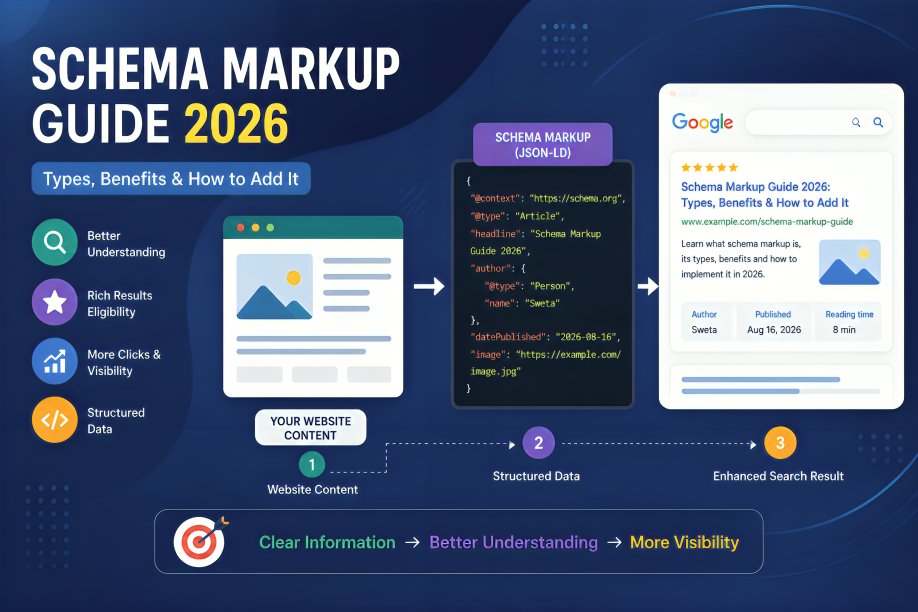
Search engines are getting smarter, but they still need context to understand what a webpage is about.
That’s where schema markup comes in.
Schema markup is structured data that helps search engines understand whether a page is about a business, product, article, course, service, event, or another type of content.
When implemented correctly, it can make eligible pages available for certain enhanced search appearances. However, schema markup doesn’t guarantee higher rankings or rich results.
In this guide, you’ll learn what schema markup is, why it matters, the most useful schema types, and how to add and test it.
What Is Schema Markup?
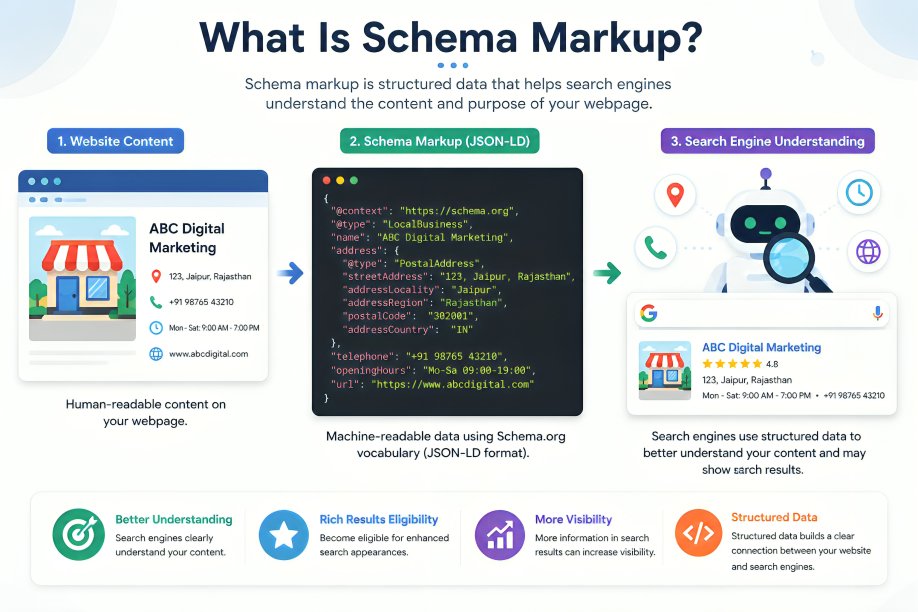
Schema markup is a machine-readable description of information on a webpage.
For example, if a page contains a business name, address, phone number, and opening hours, schema can help search engines understand that these details belong to a particular business.
Schema.org provides the vocabulary used to describe these entities and their properties. Learn more about Schema.org structured data
Common examples include:
- Organization
- LocalBusiness
- Article
- Product
- Course
- Service
- Event
- Recipe
- Person
Schema Markup vs. Structured Data
These terms are closely related but aren’t exactly the same.
Structured data is the broader concept of organizing information so machines can understand it.
Schema.org provides a standardized vocabulary for describing that information.
Schema markup generally refers to implementing Schema.org structured data on a webpage.
It can be implemented using:
- JSON-LD
- Microdata
- RDFa
For most modern websites, JSON-LD is the easiest format to manage.
Why Is Schema Markup Important for SEO?
Schema markup can give search engines clearer information about your content.
Its potential benefits include:
- Better understanding of webpage content
- Clearer identification of entities
- Eligibility for supported rich results
- More informative search appearances
- Better machine-readable context
But remember: schema is not an SEO shortcut.
A page can have perfectly valid structured data and still rank poorly or appear as a normal search result.
Think of schema as an additional layer that helps search engines understand your website.
Common Schema Markup Types
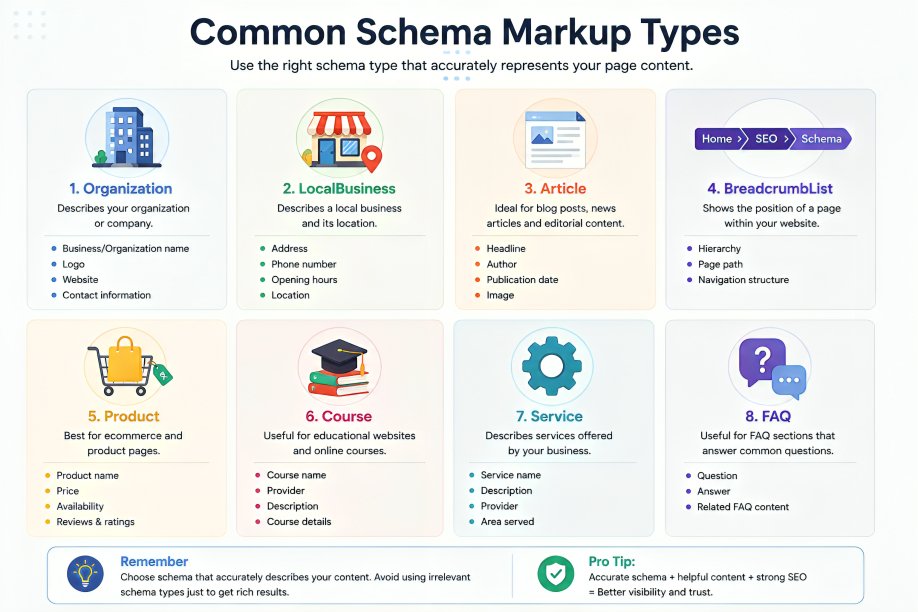
You don’t need every schema type. Choose the one that accurately represents your page.
1. Organization
Useful for company and organization websites.
It can describe:
- Business name
- Logo
- Website
- Contact information
- Other organization details
2. LocalBusiness
Useful for businesses with a local presence.
It can describe:
- Business name
- Address
- Phone number
- Opening hours
- Website
- Location
3. Article
Ideal for blog posts and editorial content.
It can provide information such as:
- Headline
- Author
- Image
- Publication date
- Modified date
For an SEO blog, Article schema is often a useful foundation.
4. BreadcrumbList
Breadcrumb schema describes where a page sits within your website structure.
For example:
Home → SEO → Technical SEO → Schema Markup
5. Product
Useful for ecommerce and product pages.
It can describe:
- Product name
- Image
- Brand
- Price
- Availability
- Reviews
Make sure the structured data matches the information visitors actually see.
6. Course
Useful for educational websites that publish genuine course information.
A course page may describe the course name, provider, description, and other relevant details.
7. Service
Useful for pages describing services such as:
- SEO
- Web development
- Digital marketing
- Web design
Only use service-related markup when it accurately describes the page.
8. FAQ
FAQ sections can be useful for visitors, but don’t add them just to chase a Google FAQ rich result.
Google has significantly restricted FAQ rich-result visibility, so FAQs should primarily focus on answering users’ questions.
How Does Schema Markup Work?
The basic process is simple:
Webpage Content → Structured Data → Search Engine Understanding → Possible Enhanced Result
For example, imagine a page about a digital marketing course.
The page contains the course name, provider, description, and other details.
Relevant structured data can communicate those details in a format search engines can process more easily.
If the page meets Google’s requirements for a supported search feature, it may receive an enhanced appearance.
Again, eligibility doesn’t guarantee display.
Before publishing, validate your implementation and follow Google’s structured data guidelines to make sure your markup follows current requirements.
JSON-LD Example
A simple Organization schema might look like this:
<script type="application/ld+json">
{
  "@context": "https://schema.org",
  "@type": "Organization",
  "name": "Example Business",
  "url": "https://example.com",
  "logo": "https://example.com/logo.png"
}
</script>
Replace the example information with your actual business details.
How to Add Schema Markup

Adding schema doesn’t have to be complicated.
Step 1: Identify the Page Type
Ask what the page actually represents.
For example:
- Company homepage → Organization
- Local business → LocalBusiness
- Blog post → Article
- Product page → Product
- Course page → Course
- Service page → Service
Step 2: Choose Relevant Properties
Add information that genuinely applies to the page.
Don’t add unnecessary properties simply to make the markup larger.
Step 3: Keep It Accurate
Avoid:
- Fake reviews
- Fake ratings
- Incorrect prices
- False business information
- Information unrelated to the page
Your structured data should accurately represent the visible content.
Step 4: Implement and Test
Add the markup using JSON-LD or another supported format, then test it before and after publishing.
How to Test Schema Markup
Don’t assume your schema works just because you’ve added the code.
A basic workflow is:
- Add the structured data.
- Test the URL using Google’s Rich Results Test.
- Fix important errors.
- Review warnings.
- Publish the page.
- Monitor the results in Search Console.
- Recheck after major website changes.
Testing is especially important when schema is generated automatically by a CMS or plugin.
Schema Markup Best Practices
Keep these rules in mind:
- Use the right schema type.
- Keep information accurate.
- Match structured data with visible content.
- Use JSON-LD when practical.
- Don’t add unnecessary schema.
- Never create fake reviews or ratings.
- Keep prices, availability, dates, and other changing information updated.
- Follow Google’s current guidelines.
- Test your markup regularly.
Schema Markup and SEO: What’s the Difference?
Schema is one part of SEO—not a replacement for it.
You still need:
- Helpful content
- Search-intent optimization
- Strong titles and headings
- Internal links
- Good website structure
- Mobile-friendly pages
- Fast performance
- Crawlable and indexable content
Think of it this way:
Great Content + Technical SEO + On-Page SEO + Relevant Schema = Stronger Overall SEO Foundation
Final Thoughts
Schema markup helps search engines better understand what your webpages represent.
The goal isn’t to add as much schema as possible. It’s to add relevant, accurate, and useful structured data.
A simple approach is:
Identify the page → Choose the right schema → Add accurate information → Test it → Monitor it → Keep it updated.
When used alongside quality content and solid SEO practices, schema markup can make your website easier for search engines to understand and potentially improve how eligible pages are presented in search.
Don’t add schema just because you can. Add it because it helps explain your content.
ALSO READ:
- AI SEO in 2026: Complete Guide to AI Search Optimization
- Google Search Console 2026: Complete Beginner’s Guide
FAQs
1. What is schema markup?
Schema markup is structured data that helps search engines understand the content and purpose of a webpage.
2. Is schema markup a ranking factor?
Schema markup is not a guaranteed ranking boost. Its main purpose is to help search engines understand your content and make eligible pages available for certain enhanced search features.
3. Is JSON-LD better than Microdata?
JSON-LD is generally easier to implement and maintain, which makes it a popular choice for modern websites.
4. Can schema markup improve rich results?
It can make eligible pages qualify for supported rich-result features, but valid schema does not guarantee that Google will display a rich result.
5. Does schema markup replace SEO?
No. Schema is only one part of SEO. You still need useful content, proper on-page optimization, technical SEO, internal links, and a crawlable website.
Aman Khati
Digital marketing expert at Gundrux. Specialising in SEO, WordPress, Social Media Automation and Faceless AI YouTube.